User Experience
Design destructive actions with understandable consequences
Deletion and cancellation need more than a generic confirmation dialog. Explain the affected records, downstream consequences, recovery limits, and actual outcome so users can decide deliberately and recover when the product permits it.
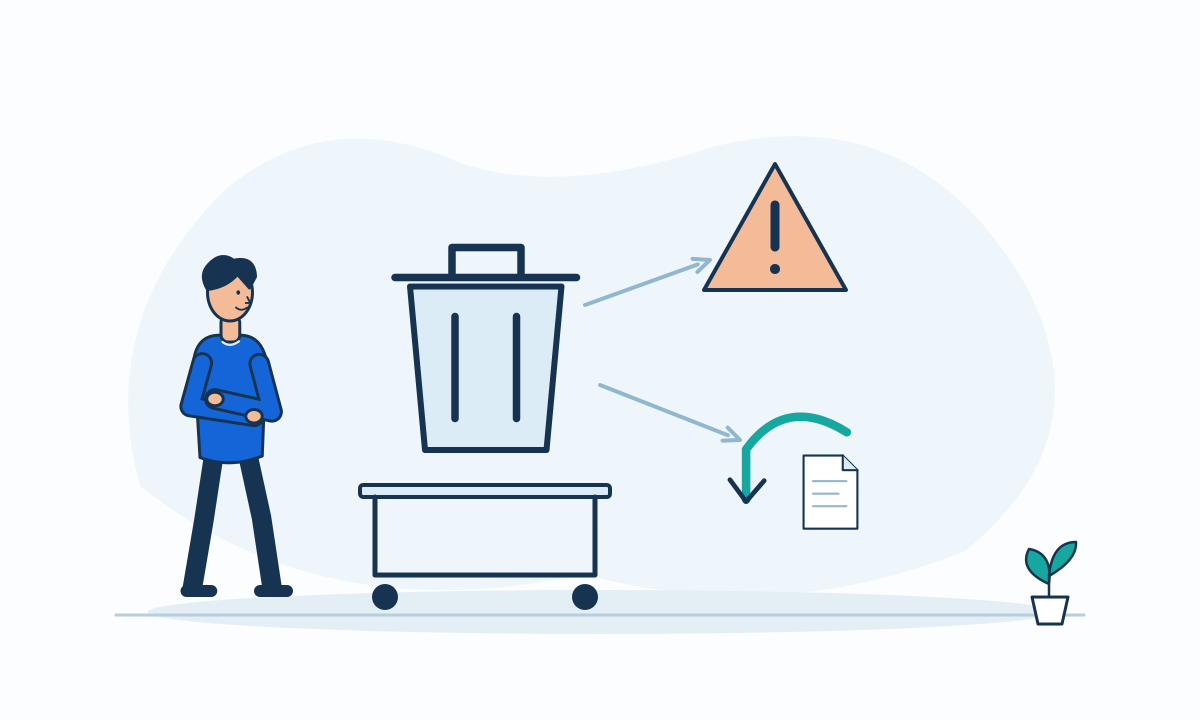
A button labeled delete can mean removing a draft, canceling a workflow, or permanently losing information. A generic confirmation leaves those differences unresolved. Before choosing the dialog design, document the real consequence of each destructive action. Users need enough information to distinguish a reversible cleanup from a business change that cannot be undone through the interface.
Describe the object and the consequence
Name the affected record in the confirmation and explain what happens to related information. Distinguish removal from the current list, archival, cancellation, and permanent deletion. Avoid promising that every copy disappears unless the product and applicable process actually support that statement.
For bulk actions, show the selection scope explicitly. Clarify whether the action affects visible rows, selected rows across pages, or every matching record. If the system cannot calculate the exact affected set, resolve that uncertainty before asking the user to confirm an irreversible action.
Choose a safeguard proportional to risk
WAI describes safeguards for certain consequential submissions, including reversal, checking, or confirmation.[7] Its explanation does not call for a confirmation on every ordinary save or edit.[7] Use that distinction to avoid adding identical warning dialogs to both low-risk and high-risk actions.
Recommend an undo route where the underlying product can genuinely restore the result. Explain any recovery boundary before commitment. If recovery depends on support or a separate business process, do not label the action as easily reversible. Additional friction cannot substitute for a truthful explanation of the effect.
Hypothetical example: canceling a training session
A hypothetical coordinator cancels a scheduled internal training session. The confirmation identifies the session and explains that participant notifications will be sent, while attendance records remain retained. This is a proposed product rule for the example, not a general claim about cancellation systems.
The coordinator can instead return to editing the session. After confirmation, the application reports whether cancellation completed and whether notifications remain pending. If notification delivery fails, it does not invite another cancellation of the same session. The message separates the completed state change from the unfinished follow-up work.
Test misunderstanding, not just button operation
Ask a reviewer to explain the consequence in their own words before confirming. If they expect a different result, revise the wording or interaction. Test similar record names, bulk selections, failed submissions, and the route back after canceling the dialog.
More friction can slow legitimate administration and encourage automatic confirmation. Reserve stronger safeguards for greater consequences. This design review supports informed action but does not establish legal adequacy or formal accessibility compliance.
- Identify the exact record or selection scope.
- Explain effects on related records and follow-up work.
- State whether and how recovery is actually possible.
- Provide a clear route to abandon the action without changes.
- Read back the resulting state before claiming completion.